Anurag Aiyer

Portfolio Website
Data Science Portfolio
Technical Skills: Python, SQL, AWS, Docker, Tableau, Airflow
Education
-
M.S., Data Science Johns Hopkins University (August 2024) -
B.S., Industrial Engineering Operations Research University of California Berkeley (May 2022)
Work Experience
Associate Product Manager @ Visa (August 2022 - June 2023)
- Created new Visa Direct Highspot learning repository for internal employees and increased employee satisfaction for accessing Highspot resources by 80%
- Performed market landscape research for Visa Consulting Analytics sustainability clients and improved client sentiment with Visa Product Design team by 80%
Retail Data Analytics Intern @ Samsung Electronics America (June 2021 - August 2021)
- Analyzed user traffic datasets using advanced statistical modeling in Python resulting in actionable insights for leadership team helping retail and carrier stores sell 75% more product to customers post-pandemic
- Developed customer demographics dashboard using data visualization techniques on Tableau to indicate ethnic groups and regions purchasing Samsung Mobile products and received 95% approval from Samsung retail analytics senior executives
Data Science Intern @ Takeda (May 2020 - August 2020)
- Developed Artificial Intelligence application by utilizing Pandas Profiling, Flask, Python, and JavaScript to easily handle any complex pharmaceutical datasets allowing users to perform deep dive analyses
- Contributed to optimizing speed and efficiency of exploratory data analysis through web application by 65% to facilitate Data Scientists across Takeda Global
Data Science Researcher @ UC Berkeley IEOR Department (January 2020 - May 2020)
- Resolved programming problems by using Python toolkit under supervision of Professor Anil Aswani in evaluation of ML bias. Maximized fairness and limited bias through multiple optimization techniques by implementing loss function by 75%
- Developed and implemented efficient SVM, Random Forest, Clustering, linear regression, and decision tree Algorithms for resolution of unique optimization problems
Projects
Predicting NYC UHI Index (March 2025)
Predicting UHI Index using Sentinel 2 and Landsat 8 satellite data bands using Planetary Computer API. All work was done using Python and Pandas using Random Forest Regression for prediction. Experimenting with different training test splits to improve test and validation accuracy from 70/30 split to 90/10 split.
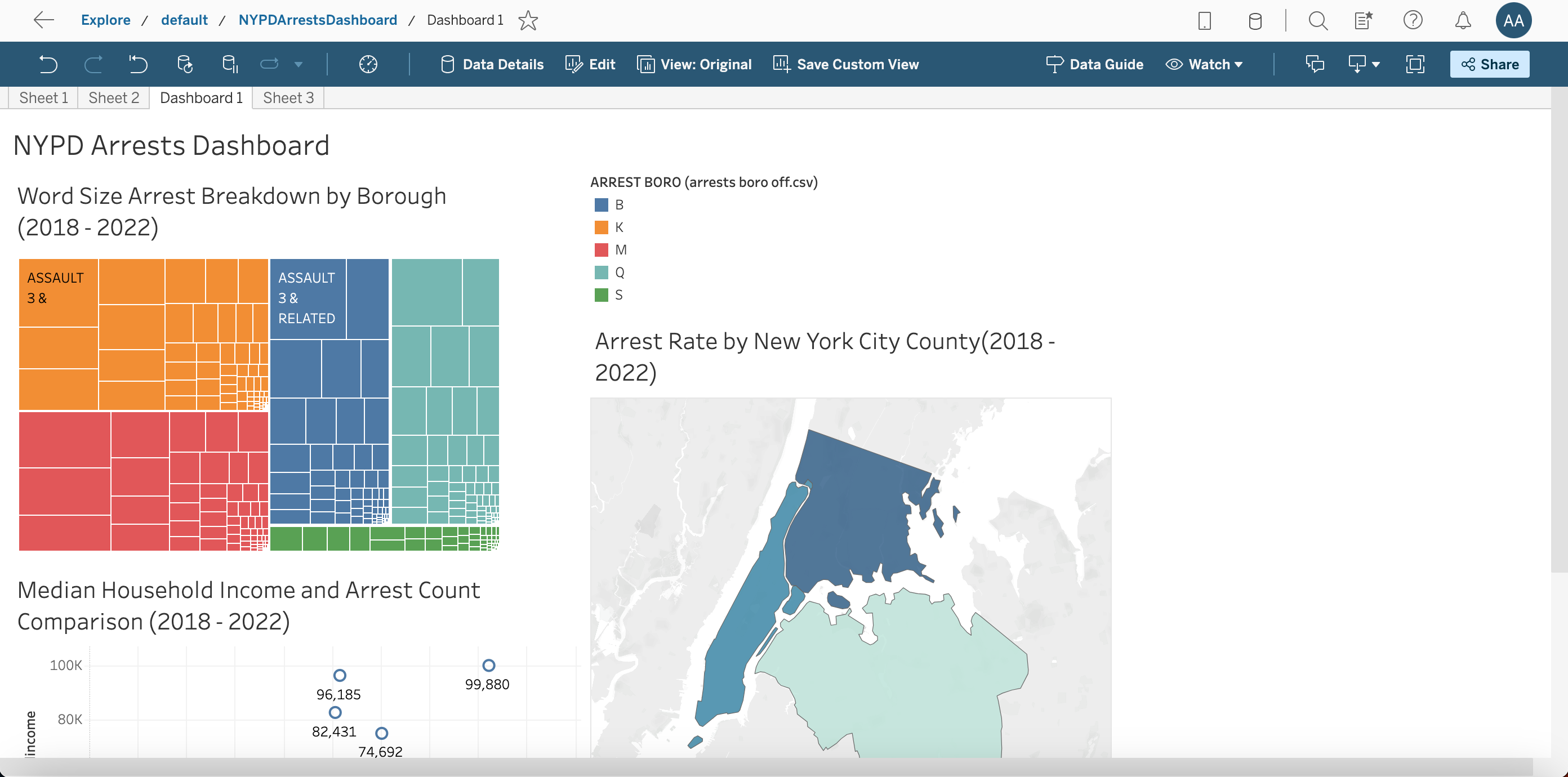
NYPD Arrests Deep Dive (August 2024)
Finding key drivers on NYC arrests by discovering noticable increase of arrests by borough, offense type, ethnicity, and age groups. We synthesized all of our findings into a Tableau dashboard, so we can better inform the NYPD how to better equip themselves to reduce crime. Our recommendations involve a collective effort in improving officer training and gain better understanding of NYC regulations.
End-to-End Data Pipeline for State Economic Metrics (August 2024)
The purpose of this data pipeline project is to streamline the integration, processing, and analysis of economic datasets from various sources like the USDA Economic Research Service and Kaggle. The project aims to deliver a self -contained data pipeline that can be deployed effortlessly using Docker. It automates data ingestion, transforms datasets with Airflow, and stores results in SQL. The documentation covers dataset descriptions, normalization into 11 tables, and the generation of pandas profiling reports for comprehensive data exploration. The architecture includes stages for data loading, transformation, and storage, with Airflow managing ETL tasks and PostgreSQL serving as the database backend.
Crypto Coin Prediction using Neural Networks (May 2024)
Dataset | Project Zip | Presentation
The goal of the project is to predict daily Bitcoin prices leveraging deep learning models learned in the Johns Hopkins Neural Network course. Research was performed into 7 different types of datasets: weekly, hourly, and daily changes. The dataset overall contains 234 Crypto Coins/Altcoins with historical Open, High, Low, Close, and Volume (OHLCV) prices traded in the Binance Exchange. Our project group chose D1 as a group since there includes more data for the daily scale and can provide high capabilities for prediction. The networks used were RNN, LSTM and GRU to compare model performance and accuracy.
Modeling Stock Market Behavior (May 2024)
The goal of the project is to build a model of how stock prices vary year over year. In order to do this, our team built a Markov chain using a stationary distribution with historical price information. Then, we compare the distribution of the Markov chain with the distribution of the test set of stock prices. This method was developed in a previous study in 2011. The data used was the closing prices of each Dow Jones Industrial average member from 2014-2019. This generates 1007 points per symbol. Overall, there are 30 symbols within Dow Jones. This was used as a reference to produce the stationary distribution of the Markov chain. We used this stationary distribution to project the stocks for 2023-2024.
Credit Card and Fico Score Exploration (April 2023)
Used Python to explore patterns between FICO scores and credit cards. From the analysis portion, Visa and MasterCard are the top two companies that authorize the highest amount of credit limit for their clients. Most middle class workers owning less than 3 credit cards have an average FICO score of 800+. Addditional steps that would be taken to further improve this project are looking at other variables, such as ethnicity, location, and education to further gain clarrification on if there is a correlation between the number of credit cards and FICO score.